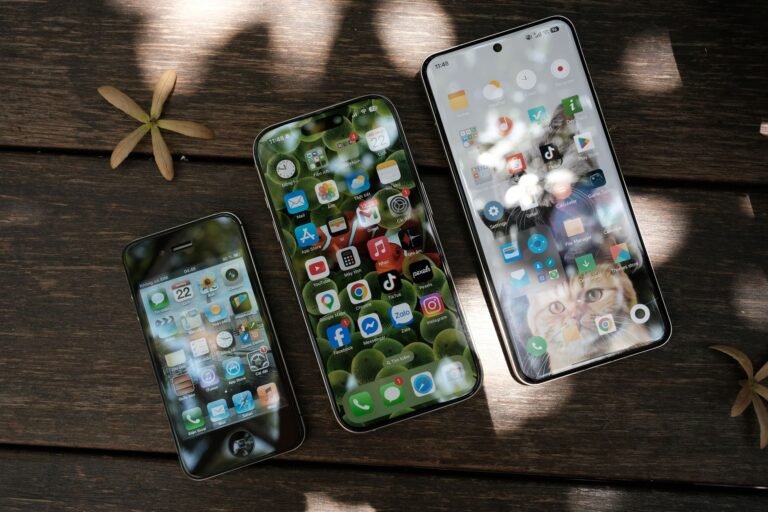
Switching between active apps, browser tabs, and game assets relies on fast temporary memory that keeps data ready for the Processor (CPU). More RAM does not make calculations finish faster by itself, but it reduces app reloads, interrupted maps, and lost draft text during busy multitasking.
You’ll see where Mobile RAM (Random Access Memory) matters, where it does not, and which memory range suits Android phones, iPhones, gaming, and everyday switching between apps.
RAM Holds Active Data While Phone Storage Holds Files
RAM acts as the phone’s short-term workspace, while Phone storage keeps photos, downloads, apps, and files after power is off. Your phone needs both, but they serve separate jobs.
A 128GB storage figure tells you how much content fits on the device. A 6GB RAM figure shows how much active work can stay close to the CPU at one time.
Active tasks sit near the chip
The operating system, open apps, game textures, browser tabs, and temporary working data occupy RAM. Qualcomm Snapdragon chips, Apple silicon, and similar processors access this workspace far faster than flash storage.
Android memory management and iOS memory management fill unused RAM with cached data. Empty RAM adds nothing, so your phone clears cached material once a foreground app needs room.
Storage space affects files, not app retention
A phone with 256GB of storage and 4GB RAM can hold thousands of photos yet reload apps during a crowded afternoon. In contrast, 12GB RAM with little remaining storage can retain tasks but leave little space for video, apps, or offline files.
Deleting photos rarely stops app reloads because photos sit in storage, not active memory. That distinction becomes clear during multitasking, where several live app states compete for RAM.
App Reloads Show How Memory Pressure Affects Multitasking
A route in Maps, a shopping cart, a music app, and six browser tabs all share a limited memory pool. More physical RAM gives your phone room to hold those states instead of removing background data for the app in front of you.
You feel pressure through small interruptions: an app returns to its splash screen, a browser tab refreshes, a draft vanishes, or task switching pauses while data loads again. These are app reloads, not always hardware faults.
Background apps are closed to protect the foreground task
An isolated reload after a long gap is normal. Mobile systems close Background apps to protect battery life, keep the foreground screen responsive, and reserve room for camera work or a demanding game.
Frequent reloads after a switch lasting less than a minute point to tighter limits. Your phone may have modest RAM, numerous active services, or battery controls that close apps earlier than expected.
Repeated tab refreshes and lost draft text deserve attention, especially after a short switch between two active apps.
Busy routines expose limited headroom
Take a commute: you open a transit app, answer a message, check an airline email, then return to the route. With enough headroom, the route stays in place; under pressure, your phone rebuilds it from storage or the network.
Split-screen work raises the load further. A video call beside a document app, plus a browser in the background, asks the system to keep several live states instead of one foreground screen.
Keeping apps resident preserves continuity, while the speed of each task still depends on the processor and graphics pipeline.
Raw Speed Comes From the CPU, GPU, and Memory Bandwidth
Once active tasks fit in memory, another 4GB does not make the CPU finish a calculation sooner. The Processor (CPU), Graphics processor (GPU), and memory controller set the pace for rendering, camera processing, and app code.
Your experience can still change with memory quality. Bandwidth describes how much data moves each second, while latency describes the wait before data arrives at the processor.
Capacity and transfer speed solve different limits
LPDDR5X moves data faster and uses less power per transferred bit than older LPDDR4X memory. That matters for image processing, on-device AI tasks, and graphics workloads that move large blocks of data.
Capacity keeps apps resident. Bandwidth feeds active work. Your spec sheet may show only gigabytes, so a 12GB phone is not automatically faster than an 8GB model with a stronger chip.
Hardware parts shape daily responsiveness
| Part | What it controls | What you feel |
|---|---|---|
| CPU | App code and system tasks | Your apps open and respond faster with stronger processing cores. |
| GPU | Graphics rendering | Your games hold higher visual settings and steadier frame rates. |
| Storage speed | Loading files and app assets | Your phone restores apps and imports media with shorter waits. |
| Cooling design | Heat control under load | Your performance drops less during a 30-minute gaming session. |
| Display load | Pixels and refresh rate | Your GPU works harder at high resolution and 120Hz. |
Heat can become the real limit during a long game. As a phone warms up, its chip lowers clock speed to control temperature, so extra RAM cannot fix an FPS drop caused by thermal throttling.
Gaming Memory Helps Session Stability More Than FPS
A game that stays resident after a notification or short app switch feels more stable. Sufficient RAM keeps the game process and its assets available, so your session returns without a full loading screen.
Frames per second follow a different path. GPU power, CPU speed, game engine code, screen resolution, graphics settings, and temperature set FPS after the game already fits in memory.
Heavy game sessions can exhaust modest RAM
Open a demanding title, join voice chat, stream music, and record the screen. That mix can fill a modest configuration and force Android to close a background service or reload game resources after an interruption.
More RAM reduces forced eviction during that workload. It does not turn a midrange GPU into a flagship GPU or make inefficient graphics code render faster.
32GB is a niche phone gaming tier
Moving from 12GB or 16GB to 32GB rarely raises FPS where the game is not memory-limited. Your benchmark result can stay unchanged because the GPU reaches its rendering limit before the larger memory pool is needed.
Choose extra memory for heavy simultaneous activity, not for a promised frame-rate jump. Heat, graphics settings, and chipset class matter far more after the game fits in RAM.
Yes, it can reduce reloads and interruptions, but higher sustained FPS needs stronger graphics hardware and effective cooling.
Those trade-offs look different across platforms because operating systems manage background processes and memory pressure in distinct ways.
Android and iPhone RAM Figures Need Platform Context
A 6GB iPhone and a 6GB Android phone do not behave as matching devices. Apple controls iOS, hardware, and app rules closely, while Android runs across Samsung, Google, Motorola, OnePlus, and other hardware designs.
Your direct gigabyte comparison misses software behavior. Android vs iPhone RAM management differs through background activity, caching, display settings, manufacturer features, and the way individual apps hold data.
Android loads vary by manufacturer
Samsung phones can run One UI services, high-refresh displays, split-screen tools, DeX desktop-style mode, and background sync tasks at once. More memory leaves room for that mix than a stripped-down Android build with fewer resident services.
Battery settings can alter app retention without a hardware change. Your Samsung device can place an app in a deep sleep category, causing it to close sooner even with physical RAM still available.
iPhone RAM needs platform-specific judgment
iOS releases memory aggressively under pressure, and iPhone apps follow Apple’s software rules. A lower listed figure can still feel smooth for your routine, though heavy camera editing and complex Multitasking still use substantial memory.
Compare phones through your daily behavior rather than RAM alone. App reload patterns, sustained gaming, camera speed, and software support reveal more than one number on a spec sheet.
RAM Ranges Match Different Phone Habits
The right amount depends on your active apps, not bragging rights. Calls and streaming place a lighter load on RAM than a 120Hz display, desktop mode, game voice chat, and dozens of browser tabs.
| Physical RAM | Fits these habits | What you should expect |
|---|---|---|
| 4GB | Calls, texts, light streaming, few open apps | Your new Android phone can feel restricted, with more tab refreshes and shorter app retention. |
| 6GB | Messaging, navigation, streaming, modest switching | Your day runs well, though heavy browser use and games expose tighter limits. |
| 8GB | Everyday multitasking, social apps, camera use, casual gaming | Your phone has comfortable headroom for mainstream Android use. |
| 12GB | Demanding games, split-screen work, frequent media editing | Your background apps stay available through heavier sessions and longer ownership. |
| 16GB | Desktop modes, large games, power-user multitasking | Your phone carries a generous margin, though many daily routines will not use it. |
For calls, messaging, streaming, navigation, and moderate app switching, it is. The 128GB figure controls file room rather than multitasking headroom.
- Light phone use Your calls, messages, music, and maps fit comfortably in 6GB under normal conditions.
- Mainstream Android use Your practical target is 8GB for smoother switching among everyday apps.
- Regular gaming Your 8GB to 12GB range leaves room for games and supporting services.
- Desktop-style work Your 12GB or 16GB configuration suits DeX, external displays, and split-screen activity.
- Longer ownership Your extra headroom matters as camera tools, browser tabs, and on-device AI features grow heavier.
How much RAM is enough for a phone depends on the workload. For many routines, 8GB already handles the common app mix; 16GB fits demanding games, desktop-style tasks, and heavier use across several years.
Virtual RAM Uses Storage as a Slower Overflow Area
Some Android brands advertise RAM expansion, memory extension, or Virtual RAM. The feature reserves part of internal storage for less urgent memory data after physical RAM fills.
Virtual RAM can retain more background state, but flash storage sits far behind physical DRAM in speed and latency. Virtual RAM vs physical RAM is not an equal comparison during rapid switching or active gaming.
Storage-backed memory has clear limits
UFS storage is fast for a phone drive, but it cannot match LPDDR memory for live processor access. A nearly full phone also leaves less space for RAM expansion and can face extra storage housekeeping.
Extra storage activity uses power and adds write traffic. Your stronger result comes from enough physical RAM at purchase, with RAM expansion serving as a fallback rather than a speed upgrade.
Your Upgrade Choice Should Follow the Actual Bottleneck
Persistent reloads are a strong sign that extra physical RAM could improve your next phone. Frame-rate dips, camera processing pauses, and slow app launches point elsewhere unless memory pressure appears alongside them.
Your choice should match the symptom disrupting your day. A stronger processor, faster storage, better cooling, or longer software support can matter more than moving from 8GB to 12GB.
- Track app reloads Your recurring launch-screen restarts after short switches point toward limited memory or strict battery settings.
- Check browser behavior Your tabs that refresh while a few apps stay open reveal pressure during real multitasking.
- Watch gaming heat Your FPS drop after 20 minutes points toward thermal throttling, not a missing RAM tier.
- Time camera tasks Your slow photo processing points toward chipset performance, image processing, or storage speed.
- Check software life Your phone stays useful longer with security updates and current operating-system versions.
Choose enough capacity for your current habits plus a modest margin for heavier apps ahead. Your stronger chipset and longer support window should not be sacrificed solely for a larger RAM number.
Final Thoughts
Smooth app switching depends more on continuity than on raw computing power. Choose 8GB for a comfortable mainstream Android experience, move toward 12GB or 16GB for sustained heavy work, and judge Mobile gaming through GPU strength and cooling before chasing 32GB.
Your daily result is simpler: fewer restarts, steadier task switching, and less lost work. RAM matters most at the point where your active apps no longer fit at the same time.
FAQ
How does mobile RAM affect phone performance?
Mobile RAM holds active apps, browser tabs, game data, and temporary system tasks close to the CPU. Your phone feels smoother because more available memory can keep background tasks open instead of forcing app reloads during multitasking.
Does more RAM make a phone faster?
Faster-feeling performance appears only after active apps no longer fit in available memory. Your CPU, GPU, storage speed, and cooling have a larger effect on app launches, camera processing, and raw graphics speed.
How much RAM is enough for an Android phone or iPhone?
Your 6GB configuration suits calls, messaging, streaming, navigation, and modest switching. Your 8GB target gives most Android phones more headroom, while 12GB to 16GB fits demanding games, split-screen work, desktop-style features, and longer ownership. iPhones need platform-specific comparison because iOS manages memory differently.
Does more RAM improve gaming FPS on a phone?
More RAM can reduce game reloads and interruptions where background apps, voice chat, music, and screen recording fill available memory. Your GPU, CPU, resolution, graphics settings, and thermal control set FPS after the game fits in memory.
Why do apps reload when switching between them?
Apps reload after the operating system removes their background state to make room for the foreground task, camera work, or a game. Your frequent reloads after short switches can point to limited RAM, active background services, or strict battery settings.
Is 6GB RAM and 128GB storage enough for a phone?
For everyday use, this memory and storage combination works well. The 6GB handles active apps and light multitasking, while your 128GB holds photos, downloads, and installed apps; heavy games, many browser tabs, or split-screen work can expose the memory limit.