
Saving 4K clips, switching between work apps, and reading outside all reveal what each phone number means in daily use. Bigger figures help in specific cases, yet a high number can hide weak camera hardware, short software coverage, or missing 5G bands.
You’ll sort processor speed, RAM, storage, displays, battery capacity, cameras, charging, durability, and long-term software details into choices that fit your routine.
A Spec Sheet Connects Hardware to Daily Use
Each line on a phone listing points to a part of your daily use. The processor affects app speed, RAM affects active tasks, internal storage holds files, and the display shapes what your eyes see for hours at a time.
Your priorities may center on long video storage, stable carrier coverage, smooth gaming, or years of security patches. A mobile phone specifications list gives you the raw parts, while your habits reveal which limits matter.
Common Terms Have Plain-English Meanings
| Term | Plain-English Meaning | What It Changes for You |
|---|---|---|
| SoC | System on a chip, the handset’s main computing package. | Your app speed, graphics, signal features, camera processing, and power draw. |
| GHz | A chip clock-speed measure. | Your speed also depends on chip design, graphics hardware, and cooling. |
| OLED | A display where each pixel produces its own light. | Your blacks look deeper, and dark scenes may draw less power. |
| LCD | A display lit through a backlight behind the pixels. | Your screen may look bright, though black areas appear grayer. |
| Refresh rate | How many times the display updates each second. | Your scrolling feels smoother at 90Hz or 120Hz than at 60Hz. |
| mAh | A battery capacity measurement. | Your runtime also depends on the screen, chip, software, and signal strength. |
| eSIM | A digital SIM built into the handset. | Your carrier plan may activate without a physical card. |
| IP rating | A dust and water-resistance classification. | Your phone has stated protection limits, not immunity from water damage. |
| USB-C | A reversible port for charging and data. | Your cable may handle charging, wired audio, storage, or display output. |
Settings Menus Show Your Current Hardware
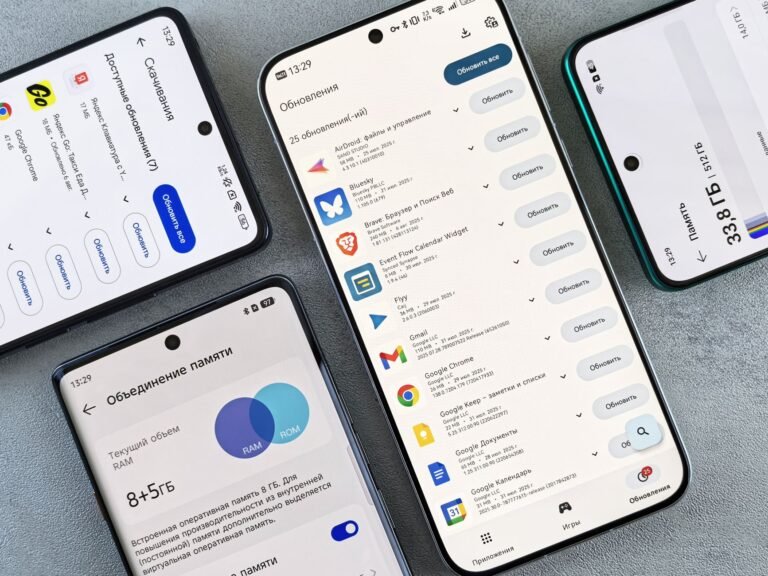
Start with the handset in your pocket. On Android, open Settings, then About Phone for the model, storage, Android version, and device identifiers. On numerous Android phones, Settings > Storage shows total and available internal storage.
Samsung lists useful details in Settings > About Phone and Settings > Battery and Device Care. Your exact model code matters because regional versions may carry different 5G bands, SIM options, and NFC hardware.
Apple iPhone details sit in Settings > General > About. Settings > General > iPhone Storage shows total and available space, while Apple’s product information for your model clarifies port, radio, and software details.
Those baseline figures matter because processing power and memory determine how smoothly the phone handles the space you have.
Processor, RAM, and Storage Set Performance Limits
That exact model code leads to the component that sets your phone’s performance ceiling: the Processor, also called the SoC. Qualcomm Snapdragon and MediaTek Dimensity chips place CPU cores, graphics, modem hardware, image processing, and power-control circuits in one package.
A 3.0GHz figure does not settle performance. Two chips with the same clock speed may produce very different game frame rates, photo processing times, 5G behavior, and heat because core design, graphics hardware, and chip fabrication differ.
RAM Holds Active Work While Storage Holds Files
RAM is short-term workspace for open apps, browser tabs, map data, and background tasks. Internal storage holds your photos, downloaded shows, games, documents, and operating system files after an app closes.
| Your Use Pattern | RAM Range | Practical Result |
|---|---|---|
| Calls, messages, web, streaming | 4GB to 6GB | Your basic apps run well, though heavy tab switching may reload content. |
| School, work apps, maps, social feeds | 8GB | Your multitasking has room for several active apps. |
| Large games, video editing, demanding use | 12GB or more | Your phone holds heavier tasks in memory, assuming the chip keeps pace. |
| Keeping a phone for several years | 8GB to 12GB | Your extra memory room helps as apps and system features grow. |
More RAM improves multitasking, yet software tuning still matters. An Apple iPhone or Android phone with efficient memory management may keep tasks responsive with less RAM than a poorly tuned handset carrying a larger figure.
Do not treat virtual RAM as equal to physical RAM. It borrows slower internal storage, so your app-switching gain may stay modest.
Storage Capacity Shapes Your Available Space
Memory headroom loses value once photos, videos, and games fill the drive. Advertised capacity includes space used by the operating system, preinstalled apps, formatting, and future updates, so a 128GB model does not leave all 128GB available for your files.
Expandable microSD storage helps on phones with a card slot, especially for local media. Yet high-speed games, camera functions, and several apps still rely on internal storage, while cloud backup depends on your internet access and account space.
128GB and 256GB Suit Different File Habits
| Typical Content on Your Phone | 128GB Capacity Fit | 256GB Capacity Fit |
|---|---|---|
| Messaging apps, 10,000 photos, cloud backup | Comfortable with routine cleanup | More room for growth |
| Offline music and several streaming downloads | Works with selective downloads | Less deletion pressure |
| Three large games and frequent 4K video | Fills fast | Stronger fit for local files |
| Long trips without dependable cloud access | Needs active file planning | Holds more media before transfer |
A 128GB vs 256GB phone storage choice depends on what stays local. A 10-minute 4K clip may consume several gigabytes, and one console-style game may take 15GB or more after patches. Your 256GB option leaves more room for large files and future app growth.
Check Settings > Storage on Android for total and available capacity. On an Apple iPhone, open Settings > General > iPhone Storage. Your total figure shows whether the handset has 128GB or 256GB, while available space shows how close it is to cleanup time.
After ensuring enough room for photos and apps, screen quality and endurance shape the experience of using them.
Display Resolution and Battery Shape Daily Comfort
Storage and speed fade into the background once a screen is hard to read or battery power runs out before dinner. Display resolution counts pixels, while refresh rate counts screen updates each second, so the two figures describe different parts of your experience.
A 60Hz panel refreshes 60 times each second. At 90Hz and 120Hz, scrolling, menus, and supported games look more fluid. Higher resolution sharpens text and images, though a very high pixel count may use more power with little visible gain on a smaller display.
Brightness Affects Outdoor Readability
OLED panels show deeper blacks because dark pixels switch off. LCD panels use a shared backlight, which can leave dark movie scenes looking charcoal rather than black. Your outdoor readability depends more directly on sustained brightness and reflection control than on panel type.
Battery capacity needs the same restraint. A 5,000mAh rating cannot predict runtime across different phones because screen size, brightness, chipset efficiency, software behavior, weak cellular signal, and your use pull power at different rates.
| Claim | What It Tells You | What You Should Check Too |
|---|---|---|
| 120Hz display | Smoother screen motion | Your battery setting and game frame-rate limits |
| High resolution | More pixels on the panel | Your viewing distance and screen brightness |
| 5,000mAh battery | Stored battery capacity | Your chip efficiency, signal, and screen runtime |
A 120Hz display may step down to 60Hz or lower during static content. Adaptive refresh behavior stretches your battery without making every screen action look sluggish.
Camera Results Depend on More Than Megapixels
A 200MP label can look decisive until sunset exposes a small sensor and shaky hands. Camera sensor size, lens quality, aperture, autofocus, optical image stabilization, and image processing shape detail, color, and blur more directly than camera megapixels alone.
Optical image stabilization moves the lens or sensor to counter hand movement during longer exposures. Your low-light photo stays sharper because the camera gathers light for longer without turning small shakes into smeared detail.
Megapixels Serve Specific Photo Tasks
Higher resolution gives you more cropping room and enables some high-resolution shooting modes. But tiny individual pixels collect less light, so phones may merge nearby pixels into one brighter output image rather than saving every shot at the sensor’s maximum count.
Judge camera claims through matched scenes. Use daylight detail for lens sharpness, dim rooms for noise and motion blur, moving pets for autofocus, portraits for edge detection, walking video for stabilization, and optical zoom for distant subjects. Your samples need the same light and shooting mode.
Carrier Compatibility and Software Coverage Affect Ownership
A strong camera and smooth display lose value on a phone that cannot use your carrier’s strongest bands. 5G connectivity varies by frequency band and regional model, so two versions with the same name may deliver different coverage or speeds in your area.
- Match model codes: Check the exact regional model against your carrier’s LTE and 5G frequency bands before choosing.
- Verify SIM format: Confirm whether your plan needs physical SIM, eSIM, dual SIM, or a stated combination.
- Check NFC hardware: Your tap-to-pay use depends on NFC hardware, which may differ across regional versions.
- Review wireless radios: Newer Wi-Fi and Bluetooth versions may improve your accessory compatibility and local network performance.
- Read update terms: Your operating system and security patch timeline affects app access and protection years later.
Fast charging has limits beyond the wattage printed on the box. Your phone needs a compatible charger, a cable rated for the needed power, and a charging standard such as USB Power Delivery. Heat slows charging near a full battery to protect battery health.
IP68 means the phone passed stated dust and water-resistance checks under specified conditions. Your handset is not permanently waterproof, and drops, worn seals, saltwater, or pressurized water may fall outside those conditions. USB-C charging behavior, repair options, materials, and software coverage still matter years after launch.
A Priority Matrix Makes Spec Comparisons Clearer
Those carrier and software checks narrow your choices before headline numbers distract you. Good phone specifications match your work, media, travel, and ownership plans rather than a universal maximum.
| Your Main Use | Highest Priorities | Lower-Priority Figures |
|---|---|---|
| Casual use | Battery runtime, 128GB storage, clear display, software coverage | Peak GHz and extreme charging wattage |
| Student use | 8GB RAM, battery, storage, Wi-Fi, durable build | High-end zoom hardware |
| Mobile gaming | SoC graphics, cooling, 120Hz display, 8GB to 12GB RAM | Megapixel count |
| Photography | Sensor size, stabilization, lenses, processing, 256GB storage | CPU clock speed alone |
| Business use | Carrier bands, eSIM, security patches, battery, storage | Maximum refresh rate |
| Heavy use | Chip efficiency, 12GB RAM, 256GB storage, thermal control | Thinness alone |
A Repeatable Spec-Sheet Method
- Match variants: Confirm your storage tier, RAM tier, and regional model before judging two listings.
- Name daily tasks: List your largest files, active apps, travel needs, camera habits, and gaming demands.
- Inspect hard limits: Check your chipset, storage, display brightness, camera hardware, and carrier band match.
- Read ownership details: Check update years, charging requirements, repair options, and water-resistance limits.
- Ignore headline traps: More GHz, RAM, megapixels, mAh, charging watts, or refresh rate does not prove a stronger phone.
Use GSMArena for side-by-side technical fields, then confirm regional details through the manufacturer’s product information. You understand smartphone specifications more clearly once your shortlist rests on limits that affect your actual routine.
Final Thoughts
Your strongest choice comes from matching the phone’s weakest relevant area to real life. A fast chip cannot repair missing carrier bands, 256GB cannot fix dim outdoor brightness, and 200MP cannot replace a capable sensor and stabilization. Put daily tasks ahead of headline numbers, then choose the model whose compromises stay outside your routine.
FAQ
What are the most important smartphone specifications to look at before buying?
Start with your Processor, RAM, internal storage, display brightness, battery capacity, carrier bands, camera hardware, and stated software coverage. Your use matters: 8GB RAM suits broad multitasking, while 256GB storage suits large games and frequent 4K video. A matching 5G band list matters more than a high GHz figure.
Which is better, a 128GB or 256GB phone?
A 128GB phone suits your lighter app library, routine cloud backup, and occasional video recording. Your 256GB option fits large games, offline media, frequent 4K clips, and several years of photo growth. Storage use matters more than the label, since system files reduce usable capacity on both versions.
What are good specs for a phone?
For most daily tasks, a capable modern SoC, 8GB RAM, 128GB or 256GB storage, clear outdoor brightness, and a stated update policy provide a strong baseline. Your carrier bands, camera needs, and battery behavior can matter more than a headline benchmark score.
How do I know if my phone is 128GB or 256GB?
On Android, open Settings and search for Storage, then check the total capacity figure. On an Apple iPhone, use Settings, General, and iPhone Storage. Your available capacity is lower because system files, installed apps, photos, downloads, and updates occupy part of the drive.
How much RAM is considered good for a phone?
Six gigabytes handles calls, streaming, browsing, and light app switching, while 8GB gives your work, school, and multitasking routine more room. Your gaming or long-term use can benefit from 12GB, though software tuning and chipset strength still shape real-world responsiveness.
How can I check my Samsung phone specifications?
Open Settings, then About Phone on your Samsung device for model details, software version, and identifiers. Your storage data appears under Battery and Device Care or Storage, depending on software version. Use the exact model number on Samsung’s product information for radio bands, port details, and hardware listings.