
A creative 3D printer should match how you actually make things, not just what the box says. Hobbyists printing cosplay helmets, teachers running classroom workshops, and engineers dialing in tight-tolerance prototypes all want different things from the machine in front of them. I built this list around the real trade-offs: build volume, filament flexibility, software friction, and how forgiving the printer is on a long overnight job. Whether you’re picking up your first spool of PLA or chasing a heated chamber for carbon-fiber blends, one of these should fit.
The Picks In Brief

Creality Ender 3 V3 SE Bundle with PLA Filament 4 Packs

ELEGOO Mercury X Bundle Cure and Wash UV Curing Machine

Semdon Metallic Yellow-Green Gradient PLA Filament 1.75mm

QIDI PLUS4 3D Printer with 65℃ Chamber and 370°C Nozzle

Bambu Lab A1 3D Printer for Beginners and Kids

FLASHFORGE Creator 5 4-Toolhead 3D Printer with 7s Toolchanger

QIDI Q2C 3D Printer with 370℃ Bimetal Hotend

ANYCUBIC Photon Mono 4 and Wash & Cure 3.0 Bundle

FLASHFORGE Creator 5 Multi-Color 3D Printer with 7s Toolchanger
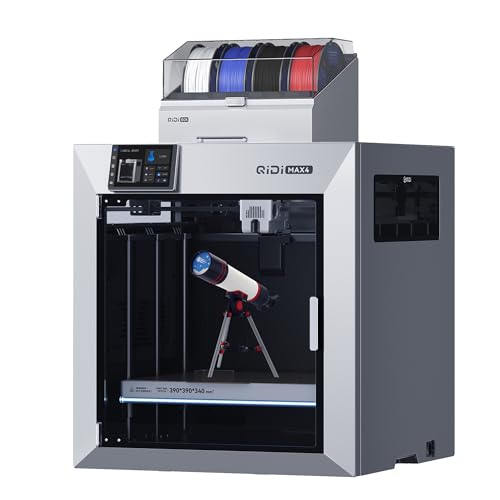
QIDI Max4 Combo 3D Printer with 390×390×340mm Build Volume
Inside Each Recommended Option
The Creality Ender 3 V3 SE is the kind of machine that gets out of your way. A CR Touch sensor handles bed leveling automatically, and a strain sensor takes care of the Z-offset (the vertical gap between nozzle and print surface), so first-time owners aren’t stuck under the printer with a sheet of paper dialing in the gap. I see it as the right starting point for someone printing Christmas gifts, cosplay parts, or classroom demos where downtime matters more than exotic filaments.
The bundle ships with four PLA spools (PLA is the most common 3D printing plastic, easy to print and biodegradable), which is a quiet perk: you’re not scrambling to find compatible filament the day the box arrives. Build volume lands in the sweet spot for most hobbyist projects without crowding a desk. Compared with the Bambu Lab A1 reviewed below, the Ender trades some plug-and-print polish for a lower entry cost.
Good Reasons To Consider
- Auto-leveling and strain-based Z-offset remove the most common beginner frustration.
- Prints up to 250mm/s with 2,500mm/s² acceleration, cutting long jobs significantly.
- Dual Z-axis lead screws (threaded rods that drive the print head vertically) reduce wobble on taller prints and keep layers aligned.
- Wear-resistant steel Y-axis linear shafts improve stability across many print cycles.
- Four included PLA spools cover colors for varied projects right out of the box.
Things To Consider
- The open-frame design collects dust on the rails over time, so monthly cleaning keeps motion smooth.
- Stock firmware is basic, and slicing (the software that converts a 3D model into printer instructions) benefits from community profiles for tricky materials.
At A Glance
Who It Suits Best
Beginners and casual hobbyists who want a forgiving FDM (Fused Deposition Modeling, the standard melt-and-extrude process) machine that doesn’t punish small mistakes.
Skip It When
You should look at the Bambu Lab A1 if multi-color printing or hands-off calibration is a higher priority than price.
Resin prints don’t end at the build plate. They need an isopropyl alcohol wash to clean uncured resin off the surface, then a controlled UV cure to harden the final piece. The ELEGOO Mercury X Bundle runs both steps in parallel from a single power adapter, so your workflow doesn’t stall waiting for one job to finish before starting the next. This matters when you’re printing a batch of miniatures or dental patterns overnight.
The wash station handles the chemistry, while the cure side uses a Fresnel lens (a ridged lens that spreads light evenly) to distribute UV across the platform. For anyone running an ANYCUBIC Photon Mono 4, reviewed below, it’s a natural pairing. If you’re strictly an FDM filament person, this bundle isn’t relevant to your setup.
Strong Points
- Dual-station design runs wash and cure simultaneously.
- Fresnel lens layout evens out UV exposure for consistent surface hardness.
- Single adapter powers both units, freeing bench outlets.
- Larger wash bucket handles bigger build plates than older Mercury models.
Worth Noting
- Isopropyl alcohol for the wash side requires safe disposal and refilling after heavy use.
- The cure chamber is sized for smaller models, so very tall prints may need repositioning mid-cycle.
Made For
Resin printer owners running frequent batches who want clean parts without babysitting each stage.
Where Another Pick Suits Better
The ANYCUBIC Wash & Cure 3.0 (paired with the Photon Mono 4 in this list) is a better fit if you want a matched-brand post-processing unit for that specific printer.
Dual-color silk filament is the easy way to give a print visual depth without post-processing. Semdon’s 1.75mm yellow-green blend shifts tone across the model, so a single vase or figurine picks up a gradient as the printer lays down layers. For cosplay props, seasonal decorations, and shelf pieces, this saves hours of hand-painting.
The 1.75mm diameter is the industry standard, so it works with most FDM printers in this list, including the Ender 3 V3 SE and the Bambu Lab A1. Owners commonly report that silk filaments prefer slightly higher nozzle temperatures and slower print speeds to keep the sheen even.
Well-Handled Touches
- Two-tone filament eliminates the need for a multi-material setup to get gradient effects.
- PLA base keeps it compatible with most entry-level FDM printers.
- Glossy silk finish reads well on decorative pieces without extra finishing work.
Honest Caveats
- Silk filament can be more sensitive to moisture, so storing opened spools in a dry box is wise.
Right Fit For
Crafters and cosplay makers who want eye-catching prints without investing in a multi-toolhead system.
A Better Fit Elsewhere
For true multi-color capability, the FLASHFORGE Creator 5 reviewed below produces distinct color regions rather than a single gradient.
Engineering filaments like ABS, ASA, PC, and nylon demand a heated build chamber to print reliably. The QIDI PLUS4 runs an active chamber heater that holds 65°C, which keeps larger prints from warping as they cool. The integrated 370°C nozzle opens the door to high-temperature composites that would clog a standard hotend.
The 12 x 12 x 11-inch build volume is generous, letting you batch several parts in one run. Compared with the QIDI Max4 Combo reviewed further down, the PLUS4 sits in the middle of the lineup: smaller chamber, but the same filament-flexibility story. It’s the right tool for small-batch manufacturing or engineering coursework.
Where It Excels
- Heated chamber reduces warping on ABS, ASA, and PC prints.
- 370°C integrated nozzle handles advanced composites like PA-CF and PEKK.
- CoreXY motion system (a layout where stationary motors move the print head via belts) supports high-throughput printing.
- 12 x 12 x 11-inch build volume fits multiple small parts at once.
Points To Note
- The enclosed chamber traps heat, so ventilation matters in home offices.
- Engineering filaments often need a heated bed at 100°C or higher, which the printer handles but adds warm-up time.
At A Glance
Best Suited To
Engineers, prototyping shops, and serious hobbyists working with materials beyond basic PLA.
Consider Something Else When
The QIDI Max4 Combo is a better fit when you need a larger build volume for industrial-sized parts.
The Bambu Lab A1 is built for people who want to print, not tinker. Out of the box, the calibration is largely automatic, and the acceleration rating of 10,000mm/s² puts it among the fastest hobbyist machines available. Multi-color printing is unlocked with the optional AMS lite accessory, so a single printer can serve a kid’s school project today and a multi-material print tomorrow.
The fully enclosed frame is a small but meaningful feature: it’s quieter, safer around curious hands, and helps hold temperature for cleaner overhangs. The footprint is compact enough for a kitchen counter or classroom shelf. For families dipping a toe into 3D printing, this removes most of the friction the Ender 3 V3 SE still leaves on the table.
What Works In Its Favor
- Ready-to-use setup skips manual calibration for first prints.
- 10,000mm/s² acceleration delivers very fast print cycles.
- Enclosed frame reduces noise and keeps curious fingers away from hot parts.
- Optional AMS lite enables multi-color prints without a toolchanger.
Trade Offs
- AMS lite is sold separately, adding to the total cost for multi-color printing.
- Compact size means larger prototypes won’t fit without splitting models.
Who Will Love This
Households, classrooms, and beginners who want fast, reliable prints without manual leveling rituals.
Look Elsewhere When
The Creality Ender 3 V3 SE makes more sense for hobbyists who want filament freedom and don’t mind a slightly more hands-on process.
Most multi-color printers rely on a single nozzle that purges old material before loading new, which wastes plastic and time. The FLASHFORGE Creator 5 sidesteps that with four independent toolheads and a 7-second toolchanger. Each extruder feeds its own filament, so swapping colors doesn’t mean flushing a long purge tower. The hardened steel nozzle (rated to 320°C) handles abrasive filaments like carbon-fiber blends.
Vibration compensation helps keep layers aligned at the machine’s high travel speeds. For a small design studio or engineering classroom, this kind of throughput changes how many iterations fit into a week.
Reasons It Performs
- Four independent toolheads print up to four colors or materials without purging towers.
- Hardened steel nozzle rated to 320°C supports abrasive composites.
- Vibration compensation maintains accuracy at high travel speeds.
Points To Keep In Mind
- Four toolheads add weight to the gantry (the moving frame that carries the print head), so the printer needs a sturdy surface.
- Toolchanger mechanics require occasional calibration checks after heavy use.
Perfect Match For
Studios and serious makers who run multi-color or multi-material jobs daily and can’t afford purge waste.
Not Your Match When
The Bambu Lab A1 with AMS lite is a simpler alternative for households that just want occasional multi-color prints.
The QIDI Q2C is the speed demon of the list. A bimetal hotend (a nozzle made of two bonded metals for better heat transfer) rated to 370°C unlocks PPS-CF and other high-performance composites, while the 600mm/s print speed puts it well above typical hobbyist machines. There’s no chamber heating on this model, so it’s less of an engineering workhorse than the PLUS4, but it moves PLA and PETG fast.
A nozzle-integrated sensor manages the first layer automatically, which helps when you’re dialing in new filaments. For a hobbyist who already knows what they’re doing and wants raw throughput, this is the right machine.
Practical Pluses
- 600mm/s print speed shortens long jobs dramatically.
- 370°C bimetal hotend supports demanding composites like PPS-CF.
- Nozzle-integrated sensor handles first-layer setup automatically.
Minor Gripes
- Without chamber heating, ABS and PC prints are likely to warp at scale.
- High print speeds demand careful slicer settings to avoid ringing artifacts (ghost-like repeating patterns on surfaces).
- Optional camera accessory does not support AI monitoring.
Built With In Mind
Advanced hobbyists who print fast with PLA, PETG, and the occasional composite, and don’t need enclosed-chamber conditions.
Reach For A Different Pick When
The QIDI PLUS4 is a stronger match when warping-prone materials are part of your regular workflow.
Resin printing is where fine detail lives, and the ANYCUBIC Photon Mono 4 pushes that further. A 10K resolution screen (9024 x 5120 pixels at 17 x 17 microns per pixel) captures textures that FDM machines can’t touch, which is why tabletop miniature painters and jewelry designers gravitate toward this format. The 153.4 x 87 x 165mm build volume handles most small-batch parts.
The bundle pairs the printer with the Wash & Cure 3.0, which has a 42% larger cleaning basket than the previous generation and a 4L bucket. A gooseneck UV light on the cure side targets the tops of models where flat lamps often leave soft spots. Working with resin is messier than FDM, so ventilation and gloves are part of the ownership picture.
Real-World Strengths
- 10K resolution screen produces fine texture and clean miniature details.
- LighTurbo matrix light source reduces visible layer lines across the build.
- Wash & Cure 3.0’s gooseneck UV light strengthens curing on model tops.
- Larger 4L cleaning bucket handles multiple parts in a single cycle.
Practical Considerations
- Resin prints require gloves, ventilation, and careful disposal of used alcohol.
- The build volume is small, so large-scale prints are out of scope.
Quick Facts
The Right Fit
Miniature painters, jewelry designers, and hobbyists who need surface detail beyond what FDM can deliver.
Swap It Out When
The Bambu Lab A1 is the better fit if you want low-maintenance FDM printing with no resin handling.
The FlashSwap system on this Creator 5 model swaps toolheads in about seven seconds, with no purging and no color bleeding between materials. Material efficiency lands around 84% compared with single-nozzle systems that purge tower after tower. The CoreXY all-metal frame holds up under the kind of daily cycling that breaks plastic-framed machines.
This is the same hardware platform as the other Creator 5 reviewed earlier, tuned for multi-color and multi-material workflows specifically. Studios running client color-matching work will appreciate that detail.
Points In Its Favor
- 7-second toolhead swaps eliminate purge waste between colors.
- CoreXY all-metal frame supports heavy daily use.
- Independent toolheads allow true multi-material prints without mixing.
Some Limits To Know
- Calibrating four toolheads takes patience on first setup.
- The price reflects the industrial-leaning feature set, so it’s overkill for hobbyist one-off prints.
Whose Shelf It Belongs On
Studios and small businesses that produce client-facing color prints and want material efficiency built in.
Another Choice May Suit
The FLASHFORGE Creator 5 standard model reviewed earlier covers similar multi-color capability for users who don’t need the full Studio workflow.
Large-format printers often sacrifice print quality for size. The QIDI Max4 Combo doesn’t, thanks to a 65°C heated chamber that keeps prints dimensionally stable as they cool. The 390 x 390 x 340mm build volume is about 55% larger than its predecessor, so you can print industrial parts, custom molds, and full prototypes without splitting them into pieces.
The full-surface silicone heated bed spreads temperature evenly, which reduces warping at the corners where first layers usually lift. For small shops that need a single printer to cover both everyday parts and large occasional jobs, this is the right tool.
Where It Helps
- 390 x 390 x 340mm build volume handles large prints in one piece.
- 65°C heated chamber reduces warping on bigger ABS and PC prints.
- Silicone heated bed spreads temperature evenly for strong first layers.
Factors To Consider
- The size of the printer demands a dedicated workbench or floor space.
- Long prints of large parts can run 24+ hours, so filament storage and bed cleaning matter.
Who Should Grab It
Small businesses and engineering labs that need industrial-sized prototypes without splitting models.
Not Your Match When
The QIDI PLUS4 is the smarter fit for users who need engineering filament capability but in a smaller footprint.
What To Weigh Before Choosing a Creative 3D Printer
The first real fork in the road is FDM versus resin. FDM machines (Creality Ender 3 V3 SE, Bambu Lab A1, QIDI PLUS4, FLASHFORGE Creator 5) melt thermoplastic filament through a heated nozzle, which makes them forgiving, affordable, and great for functional parts. Resin printers like the ANYCUBIC Photon Mono 4 cure liquid resin with UV light, which captures detail FDM can’t match but requires gloves, ventilation, and post-processing with a wash and cure station.
Build volume matters more than most shoppers expect. A printer that fits a 200mm cube handles most household prints, while industrial prototyping demands the 390 x 390 x 340mm chamber of the QIDI Max4 Combo. Measure your largest planned print before falling in love with a small footprint.
Filament compatibility separates hobbyist machines from engineering workhorses. PLA and PETG print on just about everything. ABS, ASA, PC, nylon, and carbon-fiber composites need heated chambers like the QIDI PLUS4 or Max4, plus nozzles rated to 300°C or higher. The QIDI Q2C’s bimetal hotend opens the door to PPS-CF without the chamber cost.
Software friction varies widely. Bambu Lab A1 and QIDI machines tend to ship with streamlined slicers that handle calibration in the background. Open-frame machines like the Ender 3 V3 SE often need community-curated profiles to look their best with unfamiliar filaments. Worth factoring in if a steeper learning curve is a dealbreaker.
Multi-color printing has two paths. Single-nozzle systems with an AMS unit (like the Bambu Lab A1) handle occasional color swaps cheaply. Independent toolheads like the FLASHFORGE Creator 5 cost more but skip the purge waste entirely. Material efficiency matters when filament is a recurring expense.
Smart Considerations Before You Buy
Mistakes Worth Dodging
Choosing a printer based on headline speed alone is a common trap. A 600mm/s rating means little if the slicer profile isn’t tuned to that motion system, and ringing artifacts often follow. Look for printers with vibration compensation or community-tested profiles instead.
Ignoring post-processing needs is another frequent misstep. Resin printing looks magical in product photos, but owning a wash and cure station means managing isopropyl alcohol and finding space for the units. Make sure the full workflow fits your workshop before committing.
Where The Extra Money Goes
Premium machines earn their cost through enclosed chambers, automatic calibration, and vibration compensation. These features matter when prints run for hours overnight, since a single failed first layer wastes filament and electricity.
Multi-toolhead systems like the FLASHFORGE Creator 5 cost more because each toolhead is a self-contained extruder with its own motor. That engineering removes the purge waste that adds up fast on a single-nozzle multi-color setup. For studios printing in color daily, the math usually works out.
Frequently Asked Questions
What is the difference between FDM and resin 3D printing?
FDM (Fused Deposition Modeling) melts plastic filament through a heated nozzle, layer by layer. Resin printing cures liquid photopolymer with UV light, which captures finer detail but requires post-processing in a wash and cure station. FDM is more forgiving for general use; resin wins for miniatures and jewelry.
Do I need a heated chamber for my 3D printer?
A heated chamber matters when printing ABS, ASA, nylon, or PC. These materials shrink as they cool, which causes warping in open-frame machines. For PLA and PETG, a heated chamber is unnecessary.
What does a toolchanger do on a multi-color 3D printer?
A toolchanger swaps between multiple print heads, each loaded with a different filament or color. This eliminates the purge waste that single-nozzle systems generate when switching materials.
Can I use any filament with any 3D printer?
No. Standard PLA and PETG work on most FDM printers, but engineering filaments like ABS, PC, and carbon-fiber composites need nozzles rated to 300°C or higher and often a heated chamber. Check the printer’s specs against your filament’s requirements.
How important is build volume when choosing a 3D printer?
Build volume matters when your projects exceed roughly 220mm in any direction. Smaller machines handle most household prints; larger projects like cosplay helmets or industrial prototypes need 300mm+ in each axis, like the QIDI Max4 Combo.
Closing Remarks
The right creative 3D printer depends on what you’re actually making. Beginners printing weekend projects will get the most from a Bambu Lab A1 or Creality Ender 3 V3 SE. Miniature painters chasing detail should look at the ANYCUBIC Photon Mono 4 bundle. Engineers and studios with bigger ambitions will find the QIDI PLUS4, QIDI Max4 Combo, or FLASHFORGE Creator 5 worth the investment. Match the printer to the material, the material to the project, and the project to your patience level. That’s the whole formula.